Outdoor Sofa Legs may look like a small component, yet they shape a sofa’s stability, comfort, and service life. A few millimeters can affect how a frame sits on a patio. A thin coating may also wear where legs meet damp flooring. For this introduction, the quoted specialist is fictional: outdoor-furniture engineer Lin Wei offers this practical design principle: “A reliable sofa leg must meet the floor steadily, resist the weather, and fit the frame without forcing it.” This is an original illustrative quote, not a sourced statement.
China’s manufacturers and suppliers offer options in aluminum, stainless steel, steel, and treated wood. The right choice depends on the sofa’s frame, expected load, exposure, and finish. Ask suppliers for dimensions, material specifications, surface-treatment details, and inspection procedures. Request samples when possible. Check the mounting plates, welds, screw holes, and protective feet; these small details matter during assembly and daily use. They matter more than a polished catalog photo.
A useful supplier comparison goes beyond price. Review production consistency, customization capability, packaging, lead times, and communication. Ask how the supplier checks leg height and coating quality across a batch. Then test a sample on the surface where the sofa will actually stand. Not every outdoor setting is the same. Even careful specifications can miss a practical detail, so buyers should leave room for verification before placing a large order.
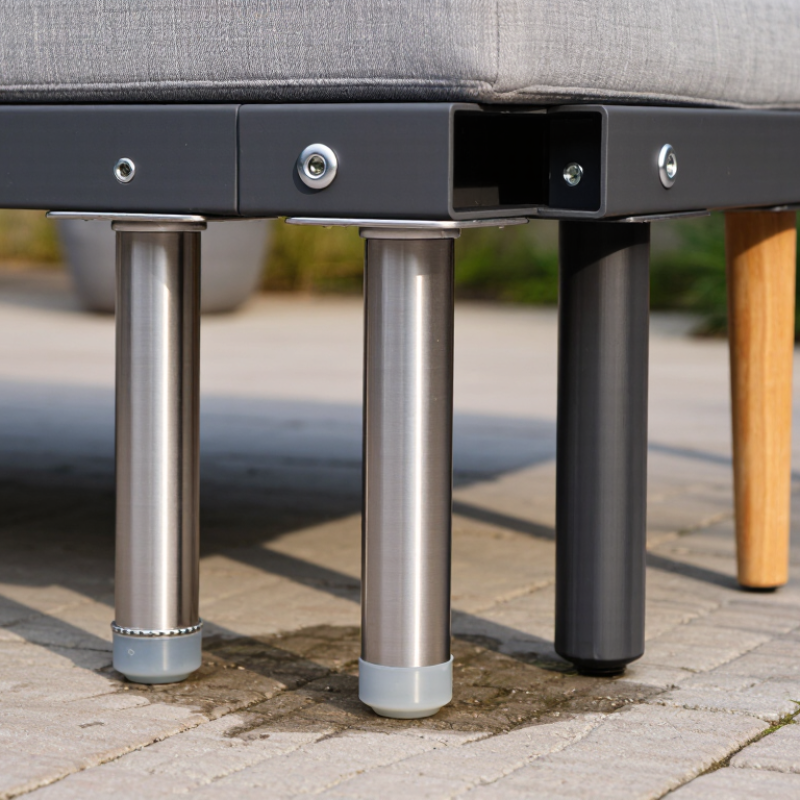
Outdoor Sofa Leg Materials: Comparing 201 and 304 Stainless Steel
Outdoor sofa legs face rain, wet paving, cleaning products, and airborne salt. Grade matters. ASTM A240/A240M lists Type 201 at 16–18% chromium and 3.5–5.5% nickel, while Type 304 contains 18–20% chromium and 8–10.5% nickel. These published composition ranges help explain why 304 generally offers more dependable corrosion resistance outdoors. Type 201 uses more manganese, but that does not make it an equal substitute for nickel in every exposure. Salt changes the equation.
For covered patios in mild inland climates, properly finished 201 legs may be a cost-conscious option. Near coastlines, pools, or frequently washed areas, 304 is usually the safer specification. Still, grade alone is not a guarantee: water trapped inside hollow legs, scratched finishes, and rough welds can create early rust spots. Ask suppliers to identify the steel grade and describe the finish, weld cleanup, and drainage details. A magnet test is not a reliable way to distinguish these grades. Check the welds. A lower quote can look attractive, but replacing corroded legs later may cost more; the right choice depends on the site and maintenance routine.
Corrosion Testing for Outdoor Legs: What ISO 9227 Salt Spray Measures
China Best Outdoor Sofa Legs Manufacturers and Suppliers
Corrosion Testing for Outdoor Legs: What ISO 9227 Salt Spray Measures
Outdoor sofa legs meet rain, damp paving, cleaning water, and salty coastal air. ISO 9227 tests a sample in a controlled salt-spray chamber to compare its corrosion resistance. For neutral salt spray, the standard specifies a solution of 50 ± 5 g/L sodium chloride and a chamber temperature of 35 ± 2°C. Inspectors can record visible rust, blistering, or coating damage using an agreed rating method. Small defects matter.
For a furniture supplier, test results help compare coatings, steel grades, and surface preparation. Pay close attention to welded joints, cut edges, and water-trapping caps; these spots can fail before broad, flat surfaces. But salt spray hours do not translate directly into years outdoors. It is a controlled comparison, not a lifespan clock. The NACE IMPACT study estimated global corrosion costs at US$2.5 trillion, or about 3.4% of global GDP, in 2016—a reminder that prevention has practical value.
Tips: Ask for the test method, exposure duration, and pass criteria. Check whether samples include real joints and edges. A neat panel result can still miss a weak weld.
China Best Outdoor Sofa Legs Manufacturers and Suppliers - Corrosion Testing for Outdoor Legs: What ISO 9227 Salt Spray Measures
| Test detail |
Neutral Salt Spray (NSS) |
Acetic Acid Salt Spray (AASS) |
Copper-Accelerated Acetic Acid Salt Spray (CASS) |
Relevance to Outdoor Sofa Legs |
| What the method does |
Exposes prepared specimens to a controlled, neutral salt-fog environment. |
Uses an acidified salt-fog environment for corrosion testing. |
Uses an acidified salt fog containing copper chloride to create a more aggressive test environment. |
Can compare specimens tested under the same specified conditions; it does not recreate every outdoor exposure condition. |
| Salt solution |
Sodium chloride solution: 50 ± 5 g/L. |
Sodium chloride solution acidified with acetic acid. |
Acidified sodium chloride solution with copper(II) chloride added. |
The test solution is controlled so results from different specimens can be compared under the same method. |
| Collected-solution pH |
6.5–7.2 |
3.1–3.3 |
3.1–3.3 |
These ranges distinguish the neutral and acidified test environments. |
| Chamber temperature |
35 ± 2 °C |
35 ± 2 °C |
50 ± 2 °C |
Temperature is controlled during exposure; it is not a direct measure of a leg’s outdoor service temperature. |
| Possible specimen types |
Metallic or coated specimens prepared and positioned according to the test method and the applicable product specification. |
A representative sample may include the same substrate and finish as the finished leg; edges, joints, holes, and damaged coating areas may need separate consideration. |
| Exposure duration |
Set by the relevant product specification, agreement, or test plan; ISO 9227 does not establish one universal duration for every product. |
Specify the test method and exposure hours before comparing supplier test reports. |
| What to record |
Record the method, specimen preparation, exposure duration, and observed corrosion or coating defects. Use the applicable product specification for the evaluation and rating criteria. |
For a useful comparison, check that the reported specimen, finish, test method, and evaluation criteria match the purchasing requirements. |
| Important limitation |
Salt spray results are comparative results from an accelerated laboratory test. They do not provide a reliable direct conversion to years of outdoor service life and do not, by themselves, define pass/fail limits. |
Outdoor Seating Safety: EN 581-2 Mechanical Requirements
Outdoor sofa legs do more than support a frame; their joints help keep a seat stable under repeated use. EN 581-2 sets mechanical safety requirements and test methods for outdoor seating intended for camping, domestic, and contract use. Testing can assess stability, strength, and durability under defined conditions. Results depend on the tested configuration, so check that the report covers the actual frame, leg design, fasteners, and intended use. A sturdy-looking leg is not proof of a safe seat.
Tips: Inspect welds and bolt connections for movement. Check that all legs sit firmly on a level floor. Ask for test documentation, and confirm which seating model and use category it covers.
Mechanical testing is only part of a practical safety check. Outdoor furniture may stand on paving, decking, or compacted ground, and small differences can affect how it feels. Look for sharp edges, loose fittings, or legs that flex during careful use. Corrosion resistance and routine maintenance also matter outdoors, even though they are separate from mechanical performance. Test results are useful, but they cannot reflect every surface or wear pattern. That limitation is easy to overlook.
China Supplier Quality Checks: ISO 9001, RoHS, and REACH Documentation
When sourcing outdoor sofa legs, inspect the paperwork alongside the metal finish, welds, and drainage details. These parts face rain, grit, and repeated movement; a neat certificate cannot prove they will resist corrosion. ISO’s ISO Survey 2022 recorded more than 1.2 million ISO 9001 certificates worldwide. That scale makes certification common, not conclusive. Check that the supplier’s certificate is current and covers the actual manufacturing site and relevant processes.
Ask for the latest test reports and material declarations, not just a general “compliant” statement. RoHS restricts certain substances in electrical and electronic equipment, so it may not apply to a standalone sofa leg. If the legs include electrical components, request evidence tied to those components and their materials. The details matter. A report for a similar coating may not match the batch you receive.
For REACH, request a dated SVHC declaration and clarify which materials it covers, including plating, paint, and plastic foot caps. ECHA’s Candidate List contained 241 entries in June 2024, illustrating why declarations need dates and updates. Verify report numbers with the issuing laboratory where possible. One limitation: supplier documents can lag behind material changes, and buyers may not catch every mismatch. Pair document review with sample inspection and batch traceability.
Comparing Chinese Sofa-Leg Manufacturers by MOQ, Lead Time, and Customization
When comparing Chinese outdoor sofa-leg suppliers, look beyond the quoted unit price. Minimum order quantities often depend on material and finish. Standard powder-coated steel legs may have a lower MOQ, while custom aluminum profiles or special colors can require larger runs. Ask whether the MOQ applies per design, finish, or total order. Small orders cost more.
Lead time needs equal care. A supplier may quote 20–30 days after sample approval, but that period may exclude tooling, color matching, or seasonal congestion. Request separate estimates for prototyping, production, and shipment readiness. For outdoor furniture, confirm the corrosion-resistant treatment and drainage-friendly design. A leg that traps water can stain patio surfaces or weaken at its joint. Details matter.
Customization is easier to assess with a dimensioned drawing, target load, and clear finish reference. Request a physical sample, then inspect welds, mounting plates, and floor-contact caps. Ask whether height adjustments affect the MOQ and whether replacement parts can be reordered later. Be cautious with vague promises of complete customization. Specifications can still change after sampling, which is inconvenient but better caught before a full production run. Supplier comparisons remain imperfect when factories calculate lead time differently, so record each quote’s assumptions.
China Outdoor Sofa-Leg Sourcing: MOQ, Lead Time & Customization
Indicative planning estimates only—not verified market-wide statistics. Standard options often involve lower order quantities and shorter lead times, while greater customization may require larger orders and more production time. Ask suppliers to confirm current MOQ, lead time, materials, finishes, and customization options.
Conclusion
Choosing reliable Outdoor Sofa Legs requires balancing material durability, safety, and production needs. This guide compares 201 and 304 stainless steel, explaining how differences in corrosion resistance can affect performance in outdoor environments. It also outlines what an ISO 9227 salt spray test measures and why its results should be considered alongside the intended use and maintenance of the furniture. EN 581-2 mechanical requirements provide a further reference for evaluating the strength and stability expected of outdoor seating.
When assessing suppliers in China, buyers can review quality-control processes and request relevant ISO 9001, RoHS, and REACH documentation for verification. Comparing minimum order quantities, lead times, and customization options can help match a manufacturer’s capabilities to a project’s schedule and specifications. A clear review of materials, test information, documentation, and production terms supports more informed supplier selection.

 Daxinghong Hardware