Choosing the right Metal Bench Legs can change more than a bench’s appearance. Leg height, mounting-plate size, steel thickness, and finish all affect fit and everyday performance. A clean powder-coated surface may suit an indoor entryway, while a corrosion-resistant finish matters more in damp settings. Small details count.
This guide to China’s top 10 metal bench leg manufacturers is intended to help buyers compare suppliers, not declare one universal winner. Manufacturer capabilities and product ranges can change, so confirm current specifications directly. Review drawings, material details, stated load ratings, sample availability, production capacity, and quality-control procedures before placing an order. Ask how dimensions are measured and whether the quoted finish applies to every surface, including welded joints. Clear answers are useful evidence; polished product photos alone are not.
A reliable comparison should also consider communication, packaging, lead times, and the supplier’s ability to make consistent batches. If possible, inspect a sample and check its mounting holes against your bench frame. A mismatch can turn a simple installation into rework. There is no perfect shortlist. Some manufacturers may excel at custom dimensions but offer fewer standard designs; others may provide faster ordering but less flexibility. The best fit depends on your project, budget, and required specifications. Use this overview as a starting point, then verify the details that matter most to your application.
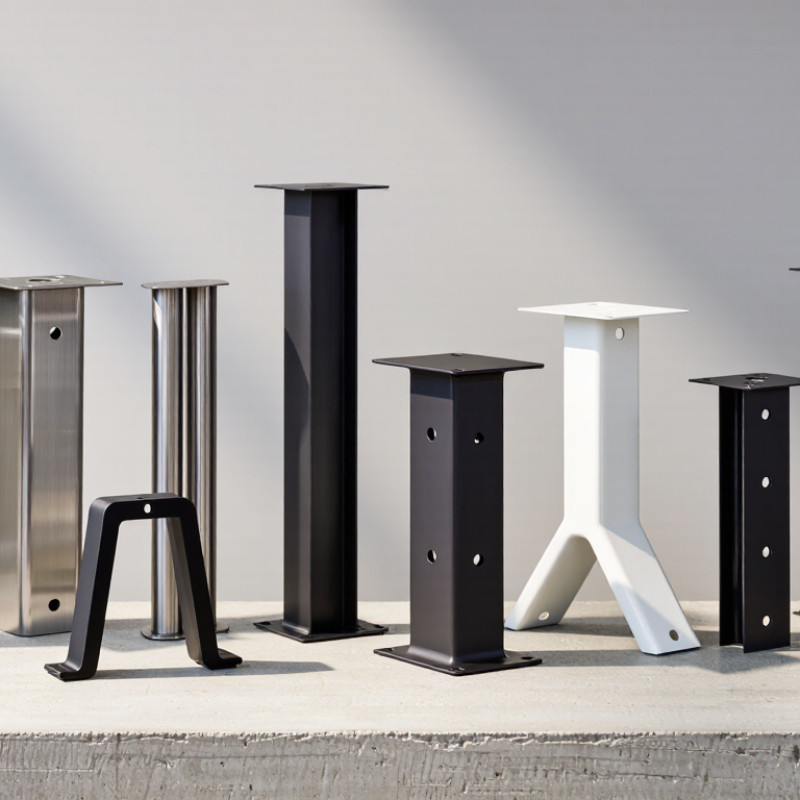
Metal bench legs are designed around load, stability, comfort, and manufacturing efficiency. Common classifications include loop legs, sled legs, pedestal bases, and four-point frames. Each shape changes how weight travels from the seat to the floor. Tubular steel suits curved profiles and reduces visible bulk. Plate steel offers stronger mounting surfaces and sharper architectural lines.
The World Steel Association reported 1.849 billion tonnes of crude steel production in 2023. That scale supports broad material availability, but material choice still matters. Designers usually compare mild steel, stainless steel, and aluminum by strength, corrosion resistance, weight, and cost. Powder coating protects indoor and sheltered outdoor legs, while stainless steel performs better in humid locations. Engineers should assess weld quality, fastener access, floor clearance, and repeated side loads. EN 12520 seating tests can guide strength evaluation, although a bench leg is not automatically compliant because it resembles tested furniture. That distinction is often missed.
Tips: Specify the expected user load, bench length, floor type, and exposure before selecting a leg. Check the complete bench assembly, not only the metal thickness. A thicker tube may still fail at a weak weld. Research reports can indicate market direction, but field testing reveals vibration, uneven floors, and installation errors. No classification is perfect. Some designs look stable but twist during everyday use. Allow room for revision.
This table presents common metal bench-leg designs and manufacturing considerations rather than a ranked list of manufacturers. Product dimensions, load ratings, finishes, and available options vary by supplier and must be confirmed against project specifications.
| No. | Leg Design / Classification | Typical Construction | Common Materials | Typical Manufacturing Methods | Common Finishes | Design and Application Notes |
|---|---|---|---|---|---|---|
| 1 | U-shaped legs | Two vertical supports joined by a horizontal base section, forming a continuous U profile. | Carbon steel or stainless steel | Tube or bar cutting, bending or welding, grinding, and finishing | Powder coating, paint, or brushed stainless steel | A simple, widely used geometry for indoor benches. Mounting plates and floor-contact details are specified to suit the seat and installation surface. |
| 2 | Inverted-U frame legs | Each support has two feet connected by an upper crossbar or mounting section beneath the seat. | Carbon steel tube; stainless steel for corrosion-sensitive settings | Tube bending, welding, drilling, and surface treatment | Powder coating, paint, or stainless steel finish | The frame can distribute support across more than one floor-contact point. Its stability depends on dimensions, bracing, joints, and the bench configuration. |
| 3 | Hairpin legs | Slender bent steel rods, commonly formed into paired or multi-rod supports. | Steel rod | Rod cutting, jig bending, welding, and finishing | Powder coating, paint, or plated finish | Often selected for a light, open appearance. Suitability for a bench depends on rod diameter, leg geometry, attachment design, and the intended loading. |
| 4 | Trapezoid legs | Angled side members joined by crosspieces to create a tapered frame. | Carbon steel tube, steel bar, or plate | Cutting, angle preparation, welding, and finishing | Powder coating, paint, or clear protective coating | The angled profile creates a distinctive stance. Cross-bracing and attachment placement can be incorporated according to the design requirements. |
| 5 | A-frame legs | Inclined members form an A-like side profile, often connected by a crossbar. | Carbon steel tube or structural steel sections | Cutting, fixture welding, drilling, and finishing | Powder coating, paint, or galvanizing for specified environments | Common in robust furniture designs. Frame proportions, weld details, and any crossbar are designed for the bench's intended use. |
| 6 | Plate-style legs | Flat or shaped steel plates support the seat, sometimes with cut-outs or folded edges. | Carbon steel plate or stainless steel plate | Laser cutting or other profiling, bending where required, welding, and finishing | Powder coating, paint, or brushed/polished stainless steel | Plate thickness, shape, and attachment points are selected during engineering. Cut-outs may reduce visual mass but require suitable edge finishing. |
| 7 | Box-section legs | Supports made from square or rectangular hollow sections, used individually or as part of a frame. | Carbon steel hollow section; stainless steel hollow section | Section cutting, end preparation, welding, drilling, and finishing | Powder coating, paint, or stainless steel finish | The closed profile provides a clean geometric appearance. End caps or adjustable feet may be specified to protect floors and close exposed ends. |
| 8 | Round-tube legs | One or more circular steel tubes form the leg or supporting frame. | Carbon steel tube or stainless steel tube | Tube cutting, bending, welding, and finishing | Powder coating, paint, or brushed stainless steel | Round sections are used in both minimalist and industrial-style designs. Tube diameter, wall thickness, and connections are project-specific. |
| 9 | Sled-base legs | Continuous bent or fabricated supports extend from the seat to floor-level runners. | Steel tube, steel bar, or stainless steel | Tube bending or fabrication, welding, and finishing | Powder coating, paint, or stainless steel finish | Runners create an elongated floor-contact profile. Glides or other floor-protection components may be used where appropriate. |
| 10 | Adjustable-foot legs | Metal supports fitted with threaded leveling feet or compatible adjustable glides. | Steel or stainless steel supports with metal or polymer foot components | Cutting, forming or welding, threaded-part installation, and finishing | Powder coating, paint, or stainless steel finish | Adjustable feet can help level a bench on uneven floors. Adjustment range, foot material, and fixing method should be checked for the installation conditions. |
Classification is commonly based on frame geometry, cross-section, material, and mounting arrangement. Load capacity is not determined by leg style alone; it depends on engineering calculations, material grade and thickness, weld quality, connections, seat construction, and applicable test requirements.
Designers consider load, stability, comfort, floor clearance, and manufacturing efficiency. The leg shape controls how weight reaches the floor.
Mild steel offers strength and lower cost. Stainless steel suits humid areas. Aluminum reduces lifting weight. No material wins every project.
Common designs include loop legs, sled legs, pedestal bases, and four-point frames. Tubular steel suits curved profiles. Plate steel creates sharper lines and broad mounting surfaces.
Ask for certified material grades, supplier records, and batch traceability. A dependable factory should provide material reports clearly. Hesitation deserves attention.
A sample reveals hole positions, tube thickness, height, weld quality, and finish consistency. Measure it with simple tools. Photos can hide small errors.
Request static-load, repeated-load, corrosion, coating-adhesion, and dimensional test results. Testing should cover the complete bench assembly, not only the legs.
A thick tube can still fail at a weak weld. Inspect penetration, seam consistency, spatter, and joint alignment. Clean appearance is useful, but not proof.
Confirm minimum order quantity, tooling ownership, packaging, delivery tolerance, and replacement-part procedures. Review one welded sample first. A fast quotation may hide repeatability problems.
Visit the facility or arrange a live video inspection. Check cutting equipment, welding stations, storage areas, and final inspection records. A polished showroom proves little.
No. A similar furniture design does not guarantee compliance. Evaluate the complete structure, expected user load, floor type, and repeated side loads. Field testing still matters.
This article explores how Metal Bench Legs are designed and classified according to factors such as shape, construction, intended use, and finish. It also outlines practical criteria for evaluating manufacturers in China, including production capacity, material options, quality-control processes, customization services, communication, and delivery reliability. These considerations help readers assess suppliers beyond price alone.
The article presents an overview of ten Chinese manufacturers and compares their potential strengths in materials, design flexibility, and production capabilities. It concludes with guidance on choosing and verifying a suitable manufacturer, such as reviewing product specifications, requesting samples, clarifying customization requirements, and confirming quality standards and lead times. The aim is to help buyers make informed decisions that fit their project needs.

 Daxinghong Hardware